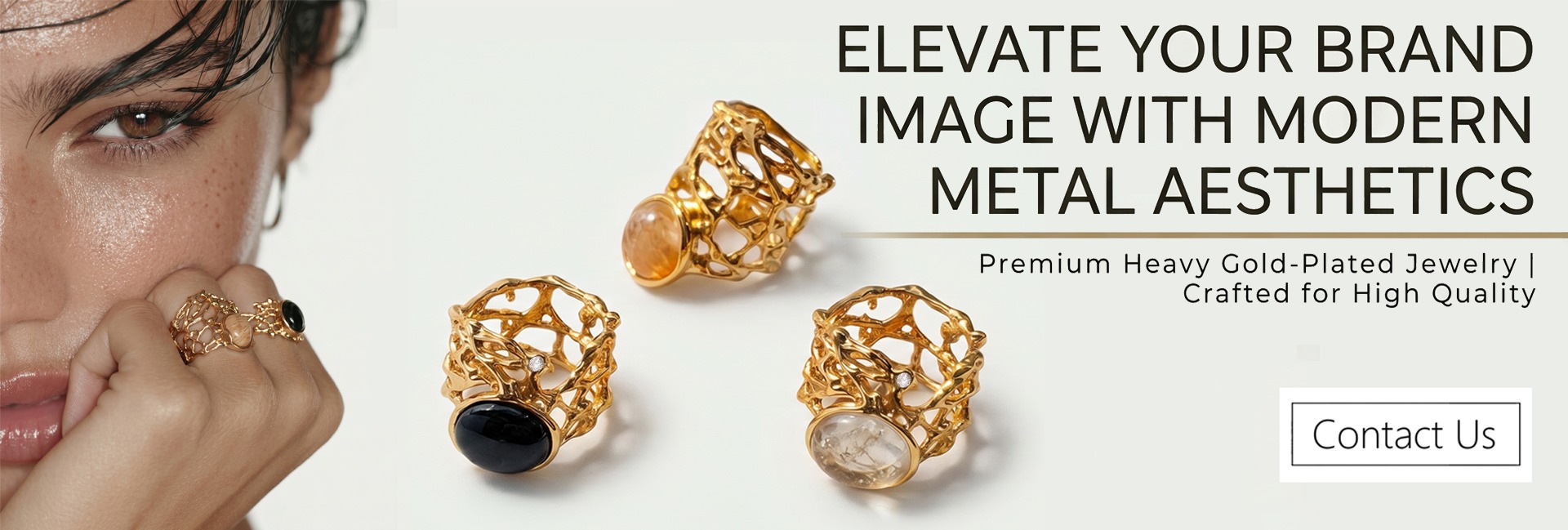
Why 2026 Is Still a Strong Year to Start a Jewelry Brand
The global jewelry market keeps growing, but the bigger shift is who is selling it. Most of the growth now comes from small brands selling direct to customers through social platforms — TikTok Shop, Instagram, and independent storefronts — rather than from legacy retail chains. The most accessible segment for a first-time founder is fashion and "bridge" jewelry: pieces plated in 14K or 18K gold over brass or stainless steel, with freshwater pearls, CZ, or natural stones. Product cost is low enough to leave real margin after marketing spend, which is exactly what a new brand needs.
The manufacturing side changed just as much. Ten years ago, a custom jewelry order typically meant a 1,000-piece minimum per style, months of back-and-forth, and heavy communication friction. Today, design-led OEM/ODM factories in Yiwu, China — such as TEYING (Yiwu Teying Technology Co., Ltd., founded in 2010) — are built around small brands: 24-hour CAD turnaround, 3-to-7-day samples, 15-to-30-day bulk lead times, and mixable MOQs across styles. That doesn't make launching easy; it makes the barrier execution, not capital. This guide covers the full path in the order you should walk it.
Step 1: Research the Market, Then Pick a Niche
Most failed jewelry brands didn't fail because of bad products — they failed because they positioned against everyone. Research comes before product, and it doesn't take weeks. A focused weekend of work is enough to avoid the most expensive mistakes.
What to research first
- Keywords. Check search volumes for phrases like "gold plated earrings," "waterproof jewelry," or "stainless steel necklace." Low-competition long-tail phrases mean cheaper ads later.
- Competitor pricing. Pull 10–20 competitors and note entry price points, best sellers, and how they differentiate (story, packaging, certifications).
- Platforms. Decide where you sell first: your own Shopify store, Amazon, TikTok Shop, or a mix. Each has different fees, ad costs, and expectations.
- Demographics. Who is buying — age, occasion (bridal, everyday, gifting), and price sensitivity drive every decision downstream.
Profitable niche examples for 2026
- Minimalist 18K-plated brass for everyday layering — crowded but massive
- Waterproof 316L stainless steel pieces for men and active wearers — fast-growing
- Contemporary freshwater pearl designs — strong gifting angle
- Enamel charm jewelry for creators and merch lines — high loyalty
- Bridal-party sets with custom packaging — high ticket, bulk orders
Pick one niche with a clear aesthetic voice. A brand selling "minimalist stacking rings under $25" will beat a brand selling "all jewelry for everyone" every single time. It also helps to look at what actually moves: TEYING keeps 562+ catalog styles in production and releases 200+ new styles every month, so a factory's catalog is a free signal of which designs are already selling. You can start from proven silhouettes instead of gambling on unproven ones.
Step 2: Design a Small, Cohesive Product Line
Resist the urge to launch 50 SKUs. Start with 5–10 pieces built around 1–2 hero designs. Sketch every piece on one page so the line reads as a single collection — same plating, same finish, same visual language. A collection that looks designed beats a warehouse that looks random.
You do not need to be a jewelry designer to launch. Two ODM paths get you to market faster than trying to invent everything yourself. Option one: choose 5–10 existing catalog styles and request color, finish, size, and branding changes. Option two: send a photo or rough sketch and let the factory's in-house design team create CAD for you — TEYING carries 11–20 R&D staff and returns CAD within 24 hours, with development samples in 3–7 days. This is the cheapest way to validate demand before you commit to custom molds or tooling.
Step 3: Choose Your Sourcing Model
Three models dominate new-brand sourcing, and the right choice depends on whether you value speed or exclusivity. The full mechanics of each — RFQs, samples, QC — are covered in detail in our custom jewelry manufacturing guide.
OEM (fully custom design)
You provide the designs; the factory engineers and produces them. Highest exclusivity, highest barrier — new tooling typically means 300–500 pieces per style. Right for founders with a clear design identity or a validated hero piece they want protected.
ODM (catalog adaptation)
Start from a manufacturer's existing styles and change plating, stones, sizes, branding, and packaging. Low MOQs, fast turnaround, proven designs. Best for most first-time founders because you are testing your brand, not an unproven silhouette.
Full private label
ODM plus a complete brand layer: custom boxes, cards, tags, and unboxing designed around your identity. Packaging minimums and costs are real line items, so read our private label jewelry packaging guide before you budget.
Whichever route you take, get everything in writing: MOQ per style, unit price, mold and tooling costs, lead times, plating specifications, packaging, and payment terms. Verbal agreements evaporate when production starts.
Step 4: Screen Manufacturers Like a Buyer, Not a Browser
The single biggest mistake new founders make is ordering from the first factory that answers a message. Run every candidate through the same screen, in order:
- Factory, not trading company. Ask for a live video tour of the workshop floor — casting, plating, and packing lines.
- History and size. Established factories win on consistency. TEYING has operated since 2010 with 101–200 staff and 50,000+ pieces of monthly production capacity.
- In-house design. Verify the R&D team exists. Ask for the engineer's name and a CAD screenshot of your piece, not a stock render.
- Certifications. RoHS and REACH compliance at minimum; lead-free, nickel-free, and cadmium-free options should be available on request.
- Sample discipline. A factory that sends CAD within 24 hours and samples in 3–7 days has process control. One that needs three weeks has problems.
- Communication. Response time and clarity matter more than you think — you will live in a group chat with this supplier for the first order.
Deeper checks — licenses, audits, payment safety — are covered in our jewelry manufacturing FAQ, which answers the questions most buyers forget to ask.
Step 5: Plan Your First Order Around Realistic MOQs
"Low MOQ" is a marketing term; what matters is the mix. Typical 2026 expectations from a mid-size Yiwu factory:
- Plated brass fashion styles (earrings, pendants): 100–300 pcs per style
- Stainless steel styles: 100–500 pcs per style
- Fully custom pieces with new molds or tooling: 300–500 pcs per style
- Mix MOQs: many factories let you pool 3–5 styles into one production run — always ask
Plan the first order for one month of projected sales plus a 15% buffer — not a year of stock. If a style sells, you can reorder in 15–30 days; if it doesn't, you learned that for a few hundred dollars instead of a few thousand.
Step 6: Price for Margin, Not Just Sales
New brands underpriced by competitors every day, then discover the unit economics don't survive advertising. The realistic math for a $12 retail pair of plated earrings looks like this:
- Landed cost per unit: $0.90 unit + $0.30 packaging + $0.15 pro-rated freight ≈ $1.35
- Platform and payment fees: ~15% of retail = $1.80
- Marketing: 20–35% of retail — the variable that makes or breaks brands
- Gross margin target: at least 4x landed cost at wholesale, more at retail
If your fully loaded cost is $1.35, you need a $12–14 retail price with 25% ad spend to stay profitable. If a competitor sells the same style at $8, your advantage has to come from packaging, story, and proof — RoHS/REACH certificates, nickel-free guarantees, unboxing experience — not from price. Decide your positioning before you set prices, not after.
Step 7: Build the Brand Layer: Packaging and Private Label
Jewelry is sold on feel, and the unboxing is part of the product. Budget for branded cards, logo tissue or pouches, and a box that survives international shipping. Custom packaging minimums usually run 500–1,000 units and add roughly $0.10–0.50 per unit depending on materials. Small touches — a thank-you card, a care card, a certificate of authenticity — lift perceived value more than they cost. For a full breakdown of boxes, cards, hang tags, and inserts, see our private label jewelry packaging guide.
Step 8: The 30-Day Launch Checklist
- [ ] Business entity filed and trademark search completed
- [ ] Niche locked, 5–10 SKU line finalized
- [ ] Manufacturer selected; contract signed covering mold ownership, QC, and lead times
- [ ] CAD approved, samples approved, bulk order placed
- [ ] Domain, store, payment, and email live
- [ ] Product photography done — 3–5 lifestyle shots per SKU
- [ ] Packaging and inserts ordered
- [ ] Pre-launch: 20–50 warm followers, 10 seeded reviews planned
- [ ] Launch: paid ads, creator seeding, launch offer live
- [ ] Reorder trigger set at 40% inventory sold
What It Actually Costs to Start: 2026 Budget Table
The ranges below reflect real budgets for a small brand sourcing from China with a first order of 300–1,000 pieces. They are totals, not monthly costs.
| Item | Budget range (USD) | Notes |
|---|
| Business registration + trademark | $300–1,000 | LLC, domain trademark class 14 |
| Branding (logo, identity, packaging design) | $500–2,500 | Fiverr to agency range |
| Website, domain, email | $150–600/yr | Shopify or WooCommerce |
| Samples (CAD + 5–10 samples) | $100–500 | Often refundable against bulk |
| First production run (300–1,000 pcs) | $2,000–8,000 | Biggest line item, scales with MOQ |
| Packaging (branded boxes, cards) | $300–1,200 | Minimums 500–1,000 units |
| Product photography | $300–1,500 | Model + flat lay + macro |
| Launch marketing (ads, UGC, creators) | $1,000–5,000 | Test budget, then scale winners |
| Buffer (legal, shipping disputes, returns) | $500–2,000 | Keep 10–15% of total |
| Total | $5,000–22,000 | Lean ODM launch at low end |
The Bottom Line
You can validate a jewelry brand in 2026 for roughly $5,000–20,000. Spend the money in the right order: research first, a tight 5–10 SKU line second, a vetted factory third, wear-tested samples fourth, and only then the brand layer. If you are ready to start the conversation, send TEYING your design, sketch, or inspiration image — WhatsApp +86 173 1087 7183, email teyingkeji@163.com, or use the quote form below for a free CAD within 24 hours.